
The Role Had a Job Description. I Was Too Close to Read It.
The parts of the job that nobody puts in writing.
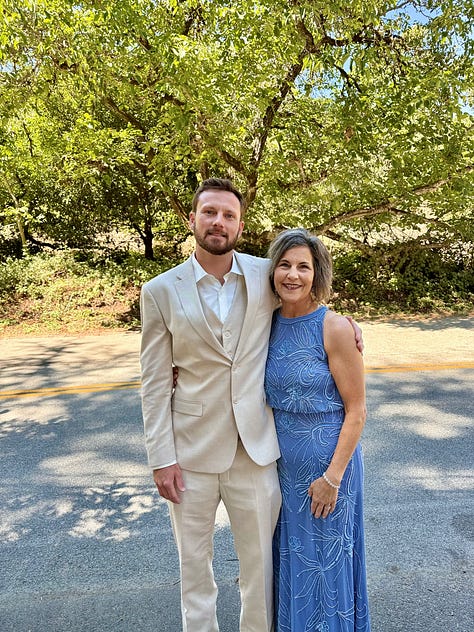
When your oldest son proposes to his long-time girlfriend, you think you know what “mother of the groom” means. Find a phenomenal dress that coordinates with the mother of the bride, host the rehearsal dinner, and provide encouragement and support (dollars or otherwise) as the couple plans their future.
Then the wedding happens, and the role turns out to have layers you didn’t anticipate. I wrote about that shift in my Reflections from a Recovering Perfectionist post. What I didn’t say there is how much it mirrors what I watch happen in book coaching sessions.
You can be fully present for an event and still not see all of its facets until you’re standing outside it.
That’s what proximity does. While you’re inside a role, an experience, a stretch of material, it’s hard to tell which part is the true center and which parts are just there to support it.
The same is true with a memoir. You can know your story down to the last detail and still not know what you want to say. Life gives you the material. But you still have to decide what it means, who needs to hear it, where the part you’re focused on begins and ends, and what belongs once you answer those questions.
A few signs tend to show up that signal when your perspective is off.
- You know what happened but can’t yet say what the book is really exploring underneath it all.
- You know what you want to say, but not who actually needs to hear it.
- Without a boundary around the timeframe, your whole life starts competing for space on the page, and the project starts looking more like autobiography than a memoir.
- Time moves on, and the story keeps accumulating with a new story or realization, and you feel frustrated that you can’t figure out what to capture.
If several of those sound familiar, this could be a sign you need an outside perspective to find a starting point. Once you have those pieces figured out, you can start building from there. But if none of those are clear, it’s easy to second-guess even starting.
Pick the one that sounds most like you, and start there. What do you want to say?
If that’s where you are right now, let’s start a conversation. The clarity comes from someone who can stand outside the material with you and tell you what’s at the center.
Join me at Book Coach Office Hours, where we talk through these questions and mull over the big questions: What DO I want to say? and What DO I want the reader to hear?
Thursday, September 17, 11 a.m. Pacific. Register here.
If you enjoyed this piece, you may also like these:
This was originally posted on my Substack.
If you enjoyed this post, you may also like these:
-
The Chapter I Cut
I cut a chapter from my memoir, one of the hardest ones to write, and honestly, it hurt a little. Writing the whole memoir was therapeutic, but this chapter was harder than the rest because it involved a relationship that was very close and deeply important to me. It challenged…
-
All The Pieces Were There. She Just Couldn’t See The Frame.
Claire came to me with a fully written manuscript for her nonfiction parenting book. We’d been friends for years, talking about the book on our walks. When I told her I was pursuing my book coach certification, she said, “I need you. Can I hire you now?” She didn’t need…
-
I Had a Plan Before I Had a Single Box
Notes from the week as the Mother of the Groom This week, my spare bedroom is filled with boxes, and each one is labeled—appetizer table, buffet, dining table, and dessert display—for my son’s wedding rehearsal dinner. It’s organized, with a detailed event plan with pictures and corresponding numbers so the…