Before the Sorting Starts, There’s a Harder Question Underneath It
I’m prepping my own ideas right now for a second book, answering the same questions I ask clients about how to decide what belongs in your memoir.
My blueprint process is adapted from Jennie Nash’s methodology (she’s the founder of Author Accelerator and the author of the Blueprint for a Book), and it’s the same one I walk every client through before she writes a single scene. In my Blueprint Intensive, we name the book’s shape before she drafts a word of it: who it’s for, what it’s really about, what belongs and what doesn’t.
Why does this scene matter? Why that answer and not another? Why now? Why this version of the story? Why should a reader care?
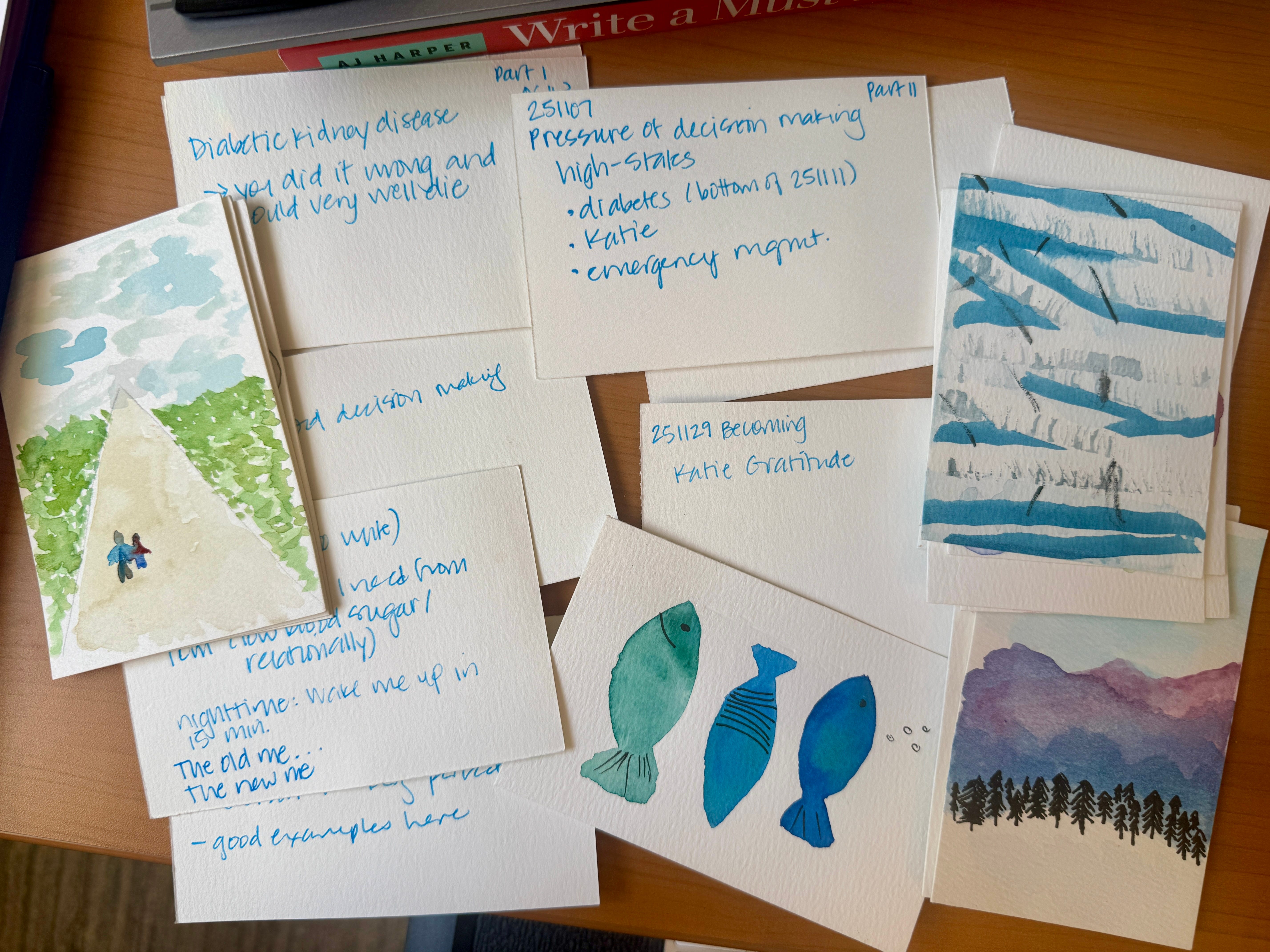
I have notecards stacked on my desk, one scene idea per card, and I don’t yet see the shape they add up to.
I know what’s on every card, but I don’t know what they mean together.
This is the part of my work I love. The moment a pile of anything sorts itself into categories I can finally see. Give me a closet or a filing cabinet, and I want to get in there. But right now, with my own material, that moment hasn’t arrived. I know exactly why.
I’m too close to it. I lived every scene on every card, so each one feels essential. Nothing wants to sort itself into central and not-this-book, because from where I’m standing, all of it is central.
There’s a second reason, and it’s the bigger one.
I haven’t decided yet what I want a reader to know or feel by the time she finishes this book.
That’s the question the Blueprint keeps forcing me back to. Not what happened. What the reader needs. Answer that, even roughly, and the cards start sorting themselves. Some move to the center, and some fall away because they matter to me but not to this reader.
I ask my clients to sit in the why of this constantly. We answer a question, and I ask why again, until we’ve moved past the first answer that sounded good and found the one that’s actually true. It’s slow. It can feel repetitive in the moment. It’s also the only way I’ve found to get underneath a story and see what it’s really doing.
Right now, I’m doing that work on myself with my own notecards, and it isn’t going any faster because I’m the one who teaches this. If anything, it’s harder. I’m both the person who lived it and the person trying to see it clearly, and those are two different jobs.
If you’ve got your own version of this on your desk right now, notecards or notebooks or a folder that keeps growing, that’s where the real work starts. Not in the writing. In the question underneath it.
What do you want your reader to know or feel when she closes the book?
I don’t have my full answer yet. I’m sitting with it, same as I’d ask you to.
If you’re at the point where you know the material but can’t yet see its shape, that’s exactly what a Discovery Call is for. You can find time on my calendar here.
This originally appeared on my Substack.
If you enjoyed this post, you may also like these:
-
You Don’t Think of Yourself as a Writer. You Just Keep Writing Things Down.
My son is about to get married, and in the middle of the countdown, I felt something I knew I’d want to remember later. So I opened a new file on my computer, titled it 260817_wedding feelings, and gave myself 15 minutes to write, which generally amounts to about 500…
-
She Says She Doesn’t Need a Coach Yet
For the woman asking, “When should I hire a book coach?” I see a lot of women sitting on the sidelines, waiting to get into the game. Most of the time, when they’re being honest, they’re afraid to reach out because they don’t have a draft yet, or they’re still thinking…
-
How Do I Start Writing a Memoir When I Have Too Many Stories?
My daughter’s birthday was the subject of a post on my Reflections from a Recovering Perfectionist Substack, and I realized that it only told a very small part of the story. What started as a blog over 25 years ago left out a lot of context, the parts that are hard…